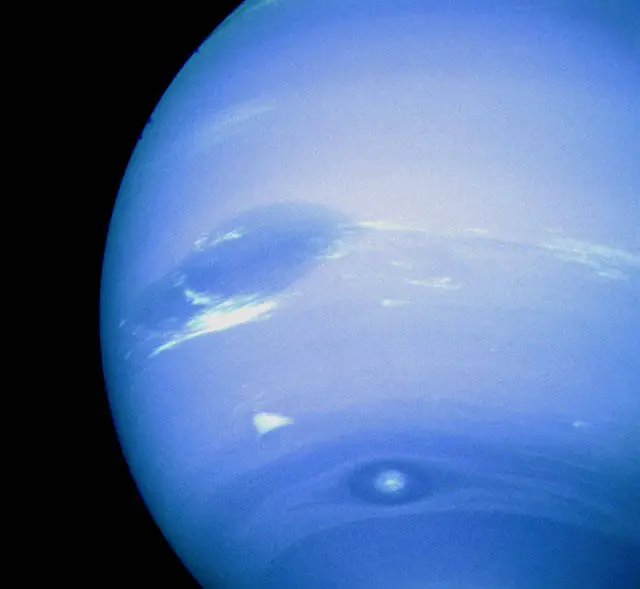
I don’t dream about hot planets
His hand was warm in mine, clasped through the bars of his crib. “I don’t dream about hot planets,” he said. “I only dream about Earth.”
“Me, too, Paul.” It’s true – I don’t think I’ve ever had a dream that takes place anywhere but earth. Wild reaches of Earth, sure. Bewildering stormy oceans and cliffs so high I fall for hours before…well, waking up. Vast arctic expanses. I dream of enormous landscapes but all that could be contained in or grown out of my world. None explicitly set on, say, Mars.
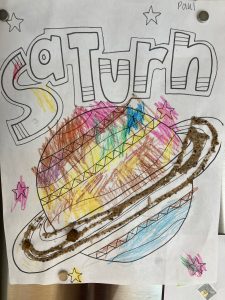
Paul is studying the planets at school. He’s brought home a painted or crayoned picture of each. Saturn with glued-sand rings, Neptune bright blue. He knows that one planet spins sideways, and it’s not Venus. That’s related to a question I’ve had recently – how do we know which way is up in space? What if the whole solar system is on its side and Uranus is the right-side-up one?
Paul’s preschool astronomy education is proving that my adult astronomy knowledge is nowhere near complete. He wants to know if there are volcanoes on Mars? What about Jupiter? And Saturn? Most of his questions, I don’t have answers to. I’ve been looking a lot of stuff up.
“Why is Mars red?” he asked. He interrupted my “I don’t know” with yet another question, but I decided to look it up. Before I could, Popular Science answered, serving me an article about a recent study connected Mars’ red dust with different type of iron oxide than previously thought –one that forms around water.
I’m keeping all his planet pictures. Flat Saturn is currently on the fridge. I’ve promised to take him on the Ithaca Sciencenter’s Sagan Planet Walk, a 5 billion scale model of the Solar System so we can both get a sense of the actual spacing of the planets.
All 7 of our sibling planets appeared on one night in late February. I didn’t look for them, but no longer locked inside by cold, I did step out onto the back garden after sunset. The stars I saw were fierce. The sight made me wonder what else is out there in my range of vision that I’m not seeing.
The first planet found orbiting a sun-like star, 51 Pegasi b, was confirmed in 1995, the year I graduated from high school. My one semester of astronomy did not mention them because they were not a thing. Now, more than 5,800 exoplanets have been identified. Astronomers reason that most stars have planets, same as our Sun with its eight orbiting acolytes.
Mercury, Venus, Earth, Mars, Jupiter, Saturn, Uranus, Neptune: I learned the same Solar System when I was a child that Paul is learning now–with the exception of down-graded mini-planet Pluto. But now our whole concept of ‘planet’ has changed. I’ve been listening to Cornell astronomers talk about exoplanets for years now, but it still astonishes me how these scientists talk not just about planets and astronomical bodies but about worlds and alien earths. A planet is a hunk of rock or a ball of gas of a certain size (sorry, Pluto) orbiting a star; a world is a self-contained system. A place you can name, with landscapes, histories, mythologies, inhabitants, a future. A thing you can dream about.
This morning’s question, on the ride to school, was: “Mom, how do trees protect us from space?”
Astonished by this beautiful, complicated question, I said something about trees contributing oxygen and taking in carbon dioxide, “keeping our atmosphere healthy and breathable and warm and distinct from the vacuum of space.”
Vacuum: the word sucked the oxygen from the car. On my side because I was thinking, “wait, IS space a vacuum?” And on Paul’s because he’s afraid of the vacuum – not the vast emptiness beyond our cozy planet but the noisy appliance we keep in the closet to clean carpets with.
“I’ll have to get back to you on that,” I said.
It turns out that I wasn’t wrong: Space is indeed “a vast, near-perfect vacuum nearly devoid of matter,” according to an astrophysicist. I’m still fuzzy on what “vacuum” means exactly, but now I know that there are a few things rattling around in space, including the interstellar medium (mainly hydrogen and helium atoms), cosmic rays, radiation, magnetic fields and dark matter.
But I had to look this up. In the moment, in the car, to divert dark thoughts about the vacuum cleaner, I turned the question back to him.
“What do you think fills space, Paul?”
“Planets!”
“And what’s between planets?”
“Moons!”
He’s surprisingly correct. While he’s not dreaming about hot planets, my kid is definitely thinking beyond his immediate range of vision, taking me with him through a second trip through this world, however many planets that contains.