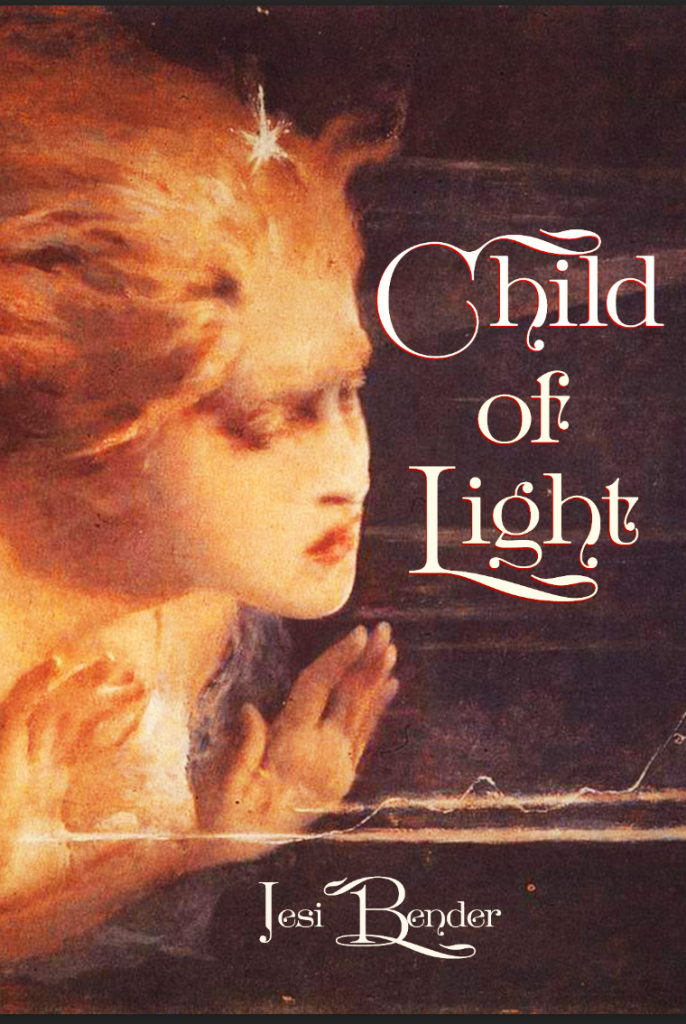
Love and electricity: The novel ‘Child of Light’
No one invented electricity, as Jesi Bender points out in her novel CHILD OF LIGHT. Like love, another element in this luminous book, electricity is simply there and all we can do is find ways to channel it.
“You do not create electricity – you generate it,” says an unnamed narrative voice in the book, which never gets ahead of its 1890s setting but often seems to float far above it. “You simply need an instrument to receive vibrations.”
But that instrument – human or machine – can break or malfunction or delay. What then?
Thirteen year old Ambrétte Memenon will soon find out. She arrives in Utica, New York in 1896 with many hopes. She wants to be closer to her mother, who is obsessed with Spiritualism and communicating with the dead. She wants to communicate with her father, a genius obsessed with electricity who only speaks French. And more than anything, she wants to bring them together.
I was captivated by this story. My heart was squeezed for Ambrétte as I remembered the excitement and apprehension of being 13. I was engrossed by the facts of the history of electricity (Nikola Tesla makes a cameo appearance) especially as it figures into a place I know well, upstate New York. And I read many passages of the book out loud. I’ll get to that in a bit. In short, I suffered alongside Ambrétte to beautiful effect. An outcome very in tune with this book, which remains grounded in the spirit of its age.
Ambrétte faces daunting challenges in Utica. The mansion Papa has built with her surly brother, Georges, has the only electrified room in the neighborhood but seems to keep the family apart more than it brings them together. The community dismisses the Memenons as odd and foreign. Maman’s and Papa’s parallel obsessions never cross. And just as she starts to gain the insight and strength to become her own person, crushing Victorian ideas of womanhood start to close in on Ambrétte.
Does she realize that despite the growing disconnection with her family, she’s learning to connect with herself? I desperately want her to. She meets a friend, a true kindred spirit, from just down the street but worlds away thanks to the steel cage of Victorian societal structure. She pursues an apparent talent for communicating with the dead, with a tragic outcome. And she learns French – enough to communicate with one important living person, her father.
In the end, it’s language that connects two humans when nothing else will. For all the terrible constrictions Ambrétte undergoes during the course of this novel, one thing that does expand is her mind, with a new language as a bit of solid evidence.
Jesi Bender describes CHILD OF LIGHT as experimental. “Experiment” in this book does not make it difficult. It makes it playful. Languages are at the forefront of that playfulness as the one Ambrette thinks in, English, and the one she’s trying to learn, French, collide and intertwine in realistic ways that add to the meaning of Ambrétte’s language barrier against her father. The barrier recedes through the course of the book toward one remarkable moment of illumination.
“We look to the sky and to each other for the same reasons – we can rely on people as we rely on the universe to always contain unreachable depths,” Papa says to his daughter in French she (finally) can understand. “These elements are ultimately unknowable. But we continue, as since the beginning of time, in vain, to take on the challenge of knowing that which has always been unknown; we endeavor to answer what is love?”
Without breaking out of the character of 1896, CHILD OF LIGHT gives an eerie premonition of electricity’s progress in the past 125 years. We’ve found ways to channel electricity. City skylines and smart phones and cryptocurrency and chatbots. But those aimed most at connecting people – the internet, social media, AI – seem to divide us more than ever.
Even though we may tut at the Victorians’ ability to electrify only one room on a city block, the Memenon family provides an important perspective: Technological progress doesn’t make us any less human.
CHILD OF LIGHT was published August 12 by Whiskey Tit. It’s marvelous. Check it out and support this independent press!