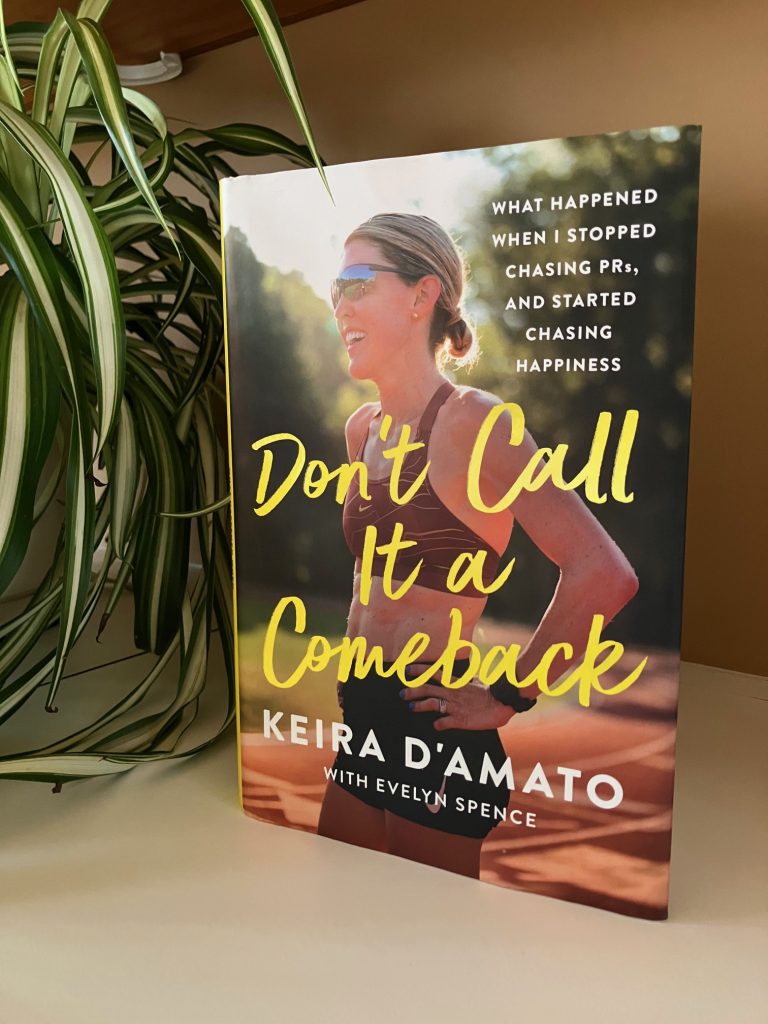
‘I love a build’: uncovering happiness in ‘Don’t Call it a Comeback’
Keira D’Amato is the opposite of me in many ways, including:
- She’s a Realtor – a very good one. On top of being a world-class distance runner, she sells houses… while I nearly failed high school yearbook class because I didn’t sell enough ad space and have not improved since.
- She’s an Extrovert, all about the group. Talk about drawing energy from being the center of the fun crowd.
- She’s crazy naturally fast. Even during the low moment she describes early on in her book, DON’T CALL IT A COMEBACK, when she set out to jog for three minutes and could not do it, that body (recovering from childbirth at that particular moment) is tuned to go fast for long distances.
- She’s confident. Keira D’Amato knows she’s freakin’ fast and owns it.
We can all learn from paying attention to, hearing stories about and (if we’re lucky) running a few miles with people who are just wired different. And in the case of me devouring Keira’s story, it’s a case of complete joy in the discovery.
You can joke around with your competitors minutes before racing a marathon???
The closest I’ve come to running with Keira D’Amato is spotting her out for a jog on Chicago’s waterfront trail the day before the Chicago Marathon last year. Killer sunglasses, colt-like stride, huge grin. “That was Keira!” I exclaimed to my friend.
Oh, and a guy in the club I ran with in Ithaca is Keira D’Amato’s uncle.
But I feel like I’m friends with her after reading DON’T CALL IT A COMEBACK, a memoir that’s not about running, she claims on page one, but rather about perseverance, going against the flow, and finding joy no matter what you’re doing. Keira just happens to run.
My biggest takeaways from Keira D’Amato’s story and her book:
Running hard doesn’t have to be a burden.
It can be fun – and a challenge at the same time. “I try to embrace the turmoil,” she writes. “It’s normal to experience dueling emotions at the same time, to have two sides to the coin: We can be excited and nervous, scared and prepared.”
This year, I’ve challenged myself to get faster. With three hard workouts a week and strength sessions, it gets stressful. A handful of times this month, I’ve come close to cancelling my midday workout because between work deadlines and family stuff I didn’t think I had it in me for one more gauntlet.
But if Keira can drop her kids off at school, show a house, change into her running clothes in her car, do a 15 mile tempo run, and be on time to her next meeting, so can I.
Running moms are strong moms
I knew this already, from experience. It’s just fun to have some professional validation.
“Running makes me a better mother,” she writes, “and being a better mother makes me a better mother, especially when it comes to putting the sport in perspective.”
Share the joy
While I savor my workout wins quietly, Keira shares those results. She’s been dubbed the Queen of Strava – the running social media platform that helped boost her through her rise from overweight jogger to Olympic Trials qualifier and beyond. “My role in the running community is to keep it light and remind everyone to smile,” she says about her corny Strava jokes and sharing all her workout info before races. “At the starting line, everyone knows what I’ve been up to, thanks to Strava.”
Fellow introverts: we don’t have to share everything all the time! Or even get on Strava: honestly, yet another social media platform cracking into the serenity of the last remaining offline place in my life, running, would stress me out. But Keira does remind me to loosen up and connect. Share a great workout result, invite a friend for a run.
“My factory settings are upbeat.”
It’s one of the lines that stands out to me most from Keira’s book. The world needs more people like this, and to hear stories from them. In DON’T CALL IT A COMEBACK we get a whole book full of them and it’s delicious.
*
With all this great stuff, I don’t quite believe the memoir’s subtitle: “What happened when I stopped chasing PRs, and started chasing happiness.” Chasing happiness can be as elusive and frustrating as chasing personal best times or wins.
I think instead that Keira D’Amato describes how she’s learned to uncover her inner joy. It was always there – as a collegiate runner trying to conform to standards of perfection; as a mom of toddlers barely catching time to get outside; as a pro challenging American records.
She’s learned to run her own way, letting the happiness she already has shine so brightly her fans and now readers can’t help getting inspired. Like me getting out of my chair to really attack my midday track workout yesterday.
I read on Instagram this week that Keira D’Amato has undergone the hip surgery she mentioned needing in the book. I wish her well in the healing process and already know she’s got this challenge, too: along with pictures of her on crutches and in physical therapy, she wrote: “I love a build.”
After reading her book, I believe it.